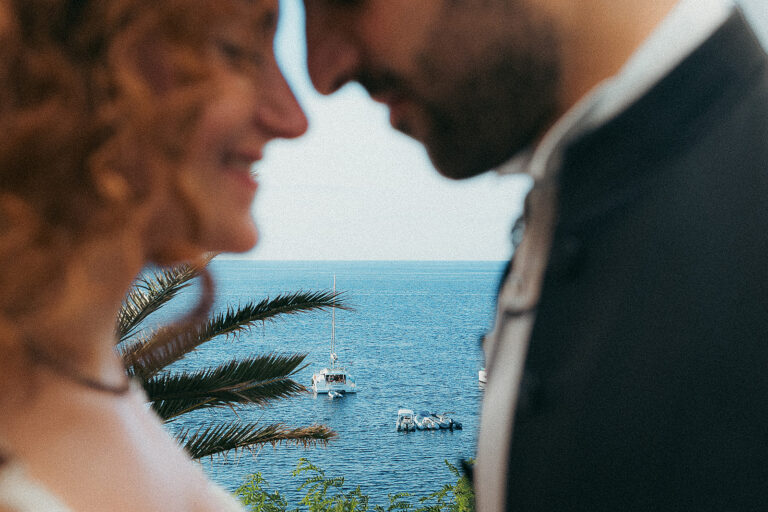
A Stromboli Elopement: Getting Married on an Active Volcano
The black sand keeps the day’s warmth long after the sun has gone. Then, somewhere above, the island clears its throat — a low rumble, felt more than heard — and nobody ever looks away. I once spent two days on Stromboli photographing a post-wedding session, and I have crossed the water for it many times since. A Stromboli elopement is not like getting married anywhere else in Italy. So here is what it asks of you, and what it gives back.
Why elope on Stromboli?
Because the island is a presence, not a backdrop. Stromboli has been erupting, gently and almost politely, for thousands of years. After dark, the glow of the crater becomes part of the sky. There are no cars here — luggage travels by electric cart through lanes barely wider than your shoulders. The houses are white, the sand is black, and the sea is everywhere you look.
For two people who want to be married rather than watched, it is close to perfect. Small is not a compromise out here. It is the only format the island accepts.
Can you legally get married on Stromboli?
Most couples choose a symbolic ceremony, and I understand why. It can happen anywhere on the island — a terrace, the black beach, a garden under the volcano — with no paperwork attached. If the legal act matters to you, a Stromboli elopement can be fully legal too. The island belongs to the Comune di Lipari, so a civil ceremony runs through the town hall and needs proper lead time. I have written a full guide to getting married in Sicily as a foreigner; read it before you set a date.
Honestly, though, most of my couples sign at home and save the island for the vows they actually remember.
How do you get to Stromboli?
By sea, and only by sea. Hydrofoils run from Milazzo, on the Sicilian coast, and stop at the other islands along the way. In summer the connections are frequent; in the shoulder months, less so. The crossing is part of the experience, because the volcano appears on the horizon long before you land.
One firm piece of advice: arrive at least a day early. When the wind rises, boats stop. And a missed connection matters far more the day before a wedding than the week before. My honest guide to the Aeolian Islands covers the logistics in more detail.
What does the day actually look like?
Slow, and built backwards from the light. There is no convoy of cars and no schedule of venues, because the whole island is a ten-minute walk. A late-morning start, a long lunch, getting ready with the windows open. The ceremony sits in the softening afternoon. Then the black beach while the light turns, and then blue hour, when the sky goes deep and the crater’s glow begins to read against it. That glow against a darkening sky is the photograph people cross oceans for.
I keep portraits short and mobile, the way I always work — presence rather than performance. On Stromboli this matters even more, because the setting does most of the talking.
What nobody tells you
The wind is a collaborator with moods. Loose veils and soft hairstyles thrive here; rigid ones struggle. Bring shoes you can lose, because the sand gets everywhere, and barefoot is often the honest answer. Rooms are few, so book months ahead, especially between June and September. Nights are genuinely dark — pack a small torch for the walk home.
And hold the plans lightly. If the sea cancels a boat, the island will still be there tomorrow. If you want to follow the volcano’s activity before you commit, the INGV, Italy’s institute of volcanology, monitors Stromboli constantly.
The island I cross the water for
Eloping in Sicily can happen in many beautiful places. Stromboli is the one I would choose if the wedding were mine. It strips everything back until only the essential is left: two people, an island, a volcano keeping time.
If you are imagining a Stromboli elopement — just the two of you, maybe a handful of witnesses — write to me. I am based in Messina, the Aeolians are home ground, and Stromboli is the island I cross the water for.